
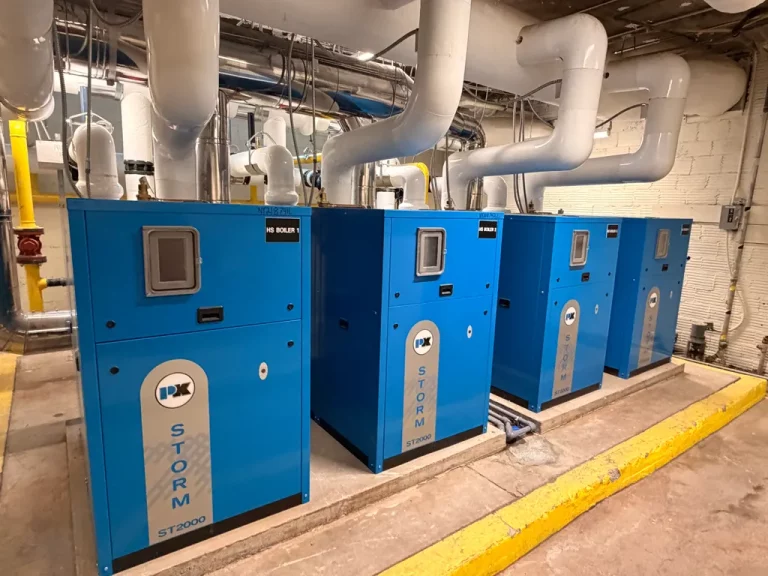
New Patterson-Kelley boiler installation to stabilize comfort heat and improve maintainability.
Introduction: Facility Profile and Project Stakes
Educational School in Upstate New York is a K–12 facility in Cortland County, New York, where stable comfort heat is essential for safe occupancy, consistent scheduling, and uninterrupted winter operations. The project required a modern boiler plant that could handle cold-weather peaks and daily load swings without relying on reactive adjustments. Adirondack Combustion Technologies (ACT) was engaged to support a new boiler installation focused on safe combustion performance, stable temperature control, and a serviceable mechanical room layout that facility staff can operate and maintain with confidence.
Project Overview: Existing System Constraints and Risks
School heating plants are exposed to rapid transitions from night setback to morning warm-up, plus occupancy-driven fluctuations throughout the day. When legacy equipment reaches end of life, reliability risk increases during winter peaks and urgent repairs become more likely.
Key constraints and risks included:
- Limited tolerance for downtime in an occupied school.
- Higher risk during cold-weather peaks when boiler reliability directly affects building use.
- Increased maintenance burden and cost when aging boilers and controls drive reactive service.
Solution: Selected Equipment and System Design Rationale
ACT supported a new boiler configuration built around a Patterson-Kelley boiler package to improve reliability and simplify seasonal operation for a school environment.
Design rationale focused on:
- Stable supply temperature control during warm-up and load transitions.
- Combustion management and safety verification aligned with institutional requirements.
- Fit with distribution piping, venting requirements, and available mechanical room space.
Consultative Execution: Engineering Approach and Coordination
ACT’s approach emphasized coordination and controlled execution so the boiler plant could be installed, verified, and handed off with clear operating expectations.
Primary support included:
- Reviewing load expectations and operating patterns typical for K–12 schedules.
- Coordinating with engineers, contractors, and facility staff on sequencing and cutover planning.
- Supporting commissioning checks and operator handoff so the maintenance team could run, monitor, and service the system predictably.
The objective was to deliver a stable, maintainable plant configuration that reduces operational guesswork during winter operation.
Results & Operational Impact: Post‑Installation Performance
This project prioritized operational reliability and controllability rather than aggressive performance claims. With a new boiler installation and verified operating setup, the facility improved its ability to maintain consistent comfort heat through winter conditions and day-to-day load changes.
Notable operational impacts included:
- More predictable heating performance during cold-weather operation and morning warm-up.
- Reduced risk of downtime associated with end-of-life boiler failures.
- Clearer operational control and serviceability for facility staff through stable setpoints and accessible equipment.
Why This Matters for Similar Facilities and Applications
Across New York, schools and municipal facilities often operate heating plants with tight reliability requirements and limited maintenance bandwidth. A coordinated boiler replacement improves stability, reduces reactive repairs, and establishes a clearer operating baseline for staff.
Adirondack Combustion Technologies supports similar projects across New York by combining equipment expertise with practical coordination, commissioning support, and operator-focused handoff. ACT can apply the same framework to other institutional facilities where comfort heat uptime is critical.
Request a Free Specification Quote
Request a free specification quote for an engineered, no-obligation review for commercial, industrial, or institutional facilities in New York. ACT can review loads, code considerations, venting constraints, and mechanical room space to define a boiler solution that fits your operating requirements.