
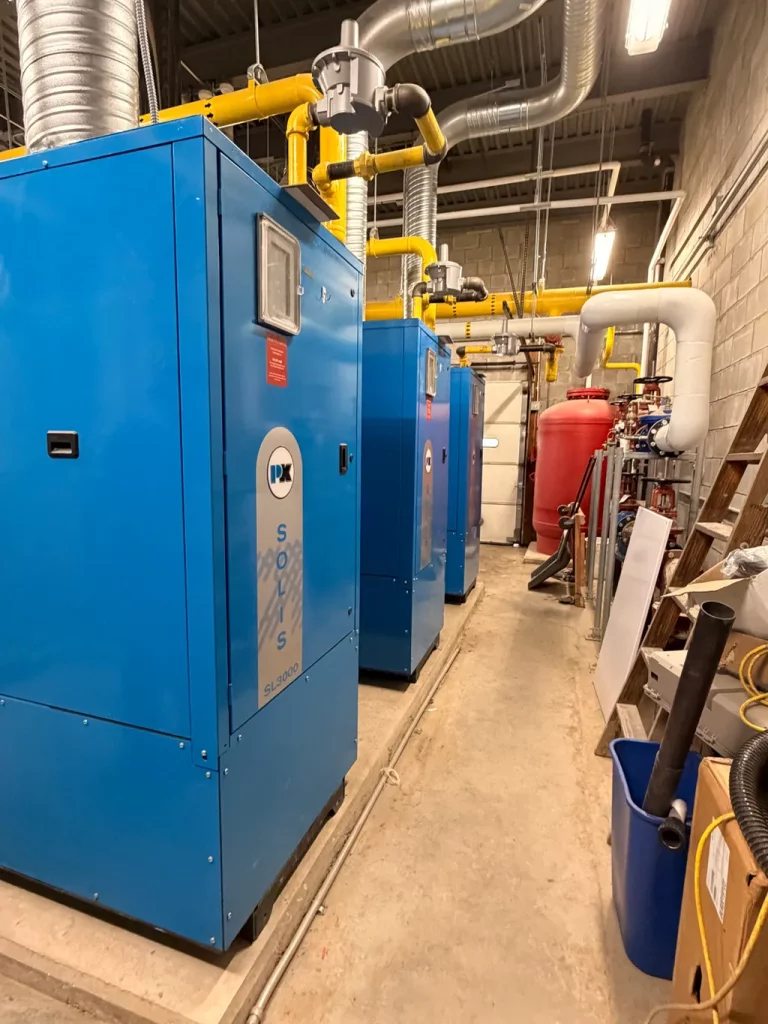
Introduction: Facility Profile and Project Stakes
Albany Region High School is a K–12 educational facility in Albany, New York, where consistent space heating is essential for occupant comfort, daily scheduling, and winter safety. The campus needed dependable boiler performance through peak cold-weather loads and shoulder-season variability. Adirondack Combustion Technologies (ACT) was brought in to support a boiler solution that would improve stability and serviceability while aligning with the facility’s operational requirements.
Project Overview: Existing System Constraints and Risks
The facility team needed to reduce operational risk and improve day-to-day reliability, with particular attention to heating stability during winter start-up and load swings.
Key constraints and risks included:
- Limited tolerance for downtime in an occupied school environment.
- The need for predictable hot water supply temperatures to maintain classroom comfort.
- Operational and maintenance exposure when a heating plant cannot respond cleanly to changing demand.
Solution: Selected Equipment and System Design Rationale
ACT specified a Patterson-Kelley Solis boiler configuration to support stable heating output and responsive part-load operation appropriate for an institutional schedule.
Design rationale focused on:
- Maintaining stable water temperatures under variable demand.
- Supporting efficient part-load performance during shoulder seasons.
- Improving maintainability and service access in a working mechanical room.
Consultative Execution: Engineering Approach and Coordination
Beyond equipment selection, ACT supported a coordination-first approach to align the boiler package with the facility’s operating realities and on-site constraints.
Primary support included:
- Reviewing heating load patterns and seasonal operating expectations.
- Coordinating with the project team on sequencing and cutover planning to minimize disruption.
- Supporting commissioning checks and basic operator handoff so the maintenance team could run the system confidently.
Results & Operational Impact: Post‑Installation Performance
After implementation, the heating plant operated with more consistent behavior under typical school scheduling and weather-driven load swings. The facility team gained clearer operational control and a more serviceable configuration.
Notable outcomes included:
- More stable heating output during start-up and load transitions.
- Reduced operational uncertainty when outdoor conditions change quickly.
- Improved day-to-day usability for facility staff managing schedules, setpoints, and maintenance.
Why This Matters for Similar Facilities and Applications
K–12 schools, higher-ed campuses, and municipal facilities across New York often face the same challenge: maintaining comfort and safety with heating plants that must perform reliably through frequent load changes.
This project shows how an equipment selection paired with practical commissioning and operator-focused coordination can improve stability and reduce operational risk. Adirondack Combustion Technologies applies this same consultative approach to steam and combustion work across New York, helping facility teams make upgrades that are practical to operate and maintain.
Request a Free Specification Quote
For commercial, industrial, or institutional facilities in New York, request a free specification quote for an engineered review. ACT can evaluate loads, code considerations, venting constraints, and mechanical room space to define a boiler solution that fits your operating requirements.