
Introduction: Facility Profile and Project Stakes
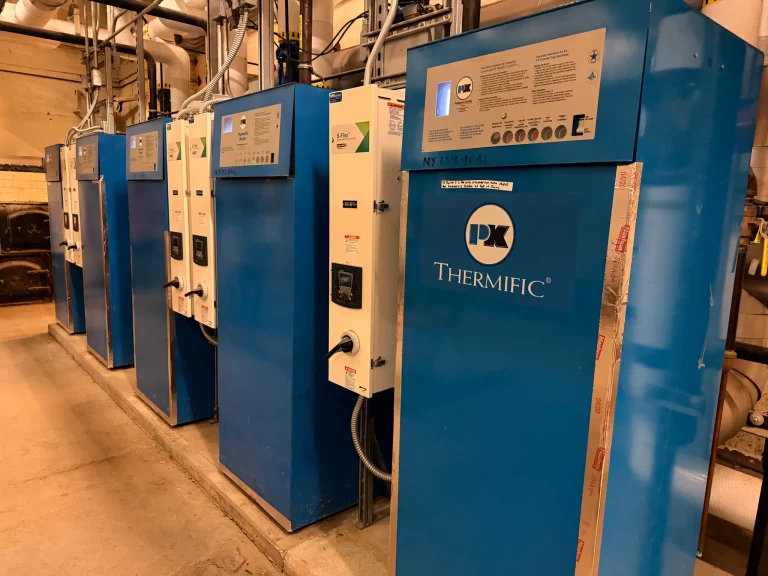
Capital Region School is a K–12 facility in Albany, New York, where consistent building heat is essential for safe occupancy, uninterrupted scheduling, and winter operations. The heating plant includes a Patterson-Kelley Thermific boiler that has been in service since 1997, making disciplined upkeep a critical part of risk management. Adirondack Combustion Technologies (ACT) was engaged to maintain reliability and control lifecycle costs by keeping combustion performance, safety devices, and operating setpoints in a stable, well-documented condition.
Project Overview: Existing System Constraints and Risks
Operating legacy boiler equipment in an occupied school creates a narrow margin for error, especially during cold-weather start-up and when staffing changes affect day-to-day plant oversight. Age alone does not dictate failure, but deferred maintenance increases the likelihood of unplanned shutdowns, unstable operation, and higher repair costs.
Key constraints and risks included:
- Limited tolerance for downtime in an occupied school building.
- Higher exposure to nuisance trips when burners and safety circuits are not verified and adjusted routinely.
- Increased lifecycle cost when small issues (leaks, ignition wear, fouling, sensor drift) compound into urgent repairs.
Solution: Selected Equipment and System Design Rationale
The solution was not a replacement project. It was a maintenance-first approach designed around the Thermific boiler’s operating profile and the facility’s winter reliability requirements. Patterson-Kelley was treated as a single manufacturer entity in documentation and service planning to keep records clear and to avoid fragmented assumptions about parts, controls, and service procedures.
The maintenance strategy was selected to support:
- Stable combustion performance and clean ignition across seasonal start-ups.
- Verified safety operation through routine checks of limits, interlocks, and flame safeguard functions.
- Predictable operation and serviceability with clear baselines for readings, setpoints, and inspection intervals.
Consultative Execution: Engineering Approach and Coordination
ACT’s role focused on practical plant reliability rather than one-time service calls. The approach emphasized consistent inspection routines, clear documentation, and coordination with the facility team so operational expectations were understood and repeatable.
Primary support included:
- Reviewing observed operating behavior and identifying conditions that typically drive nuisance shutdowns.
- Establishing a repeatable inspection and tuning cadence aligned with the school calendar and weather-driven risk windows.
- Coordinating with on-site staff on access, lockout procedures, and after-service verification so the plant returned to service in a controlled manner.
The objective was to reduce uncertainty for the maintenance team by keeping the boiler’s normal readings and protective functions well understood, rather than relying on reactive troubleshooting.
Results & Operational Impact: Post‑Installation Performance
This was a reliability program, not a new installation, so outcomes were measured in operational stability and cost control rather than headline performance claims. With regular preventative maintenance, the facility maintained dependable heating service from legacy equipment and reduced the likelihood of avoidable failures during peak season.
Observed operational impacts included:
- More predictable start-up behavior and fewer avoidable interruptions driven by maintenance-related issues.
- Better visibility into boiler condition through consistent inspection records and baselined readings.
- Lower exposure to urgent repair scenarios by addressing wear items and small deficiencies early.
For the school, that translated to fewer heating-related disruptions, clearer maintenance planning, and a more controlled lifecycle path for equipment that has already delivered decades of service.
Why This Matters for Similar Facilities and Applications
Many New York facilities operate heating plants past the typical replacement window, particularly in K–12 schools, municipal buildings, and light industrial sites where budgets are planned over long cycles. In those settings, reliability comes from disciplined maintenance, verified safety performance, and early identification of small problems before they create downtime.
Adirondack Combustion Technologies supports similar facilities by applying a consistent, engineering-informed service model that prioritizes safe operation, predictable performance, and clear documentation. ACT can apply the same approach to other legacy boiler plants where the goal is to extend useful life while managing operational risk.
Request a Free Specification Quote
Request a free specification quote for an engineered, no-obligation review for commercial, industrial, or institutional facilities in New York. ACT can review loads, code considerations, venting constraints, and mechanical room space to define a maintenance plan or lifecycle path that fits your operating requirements.