
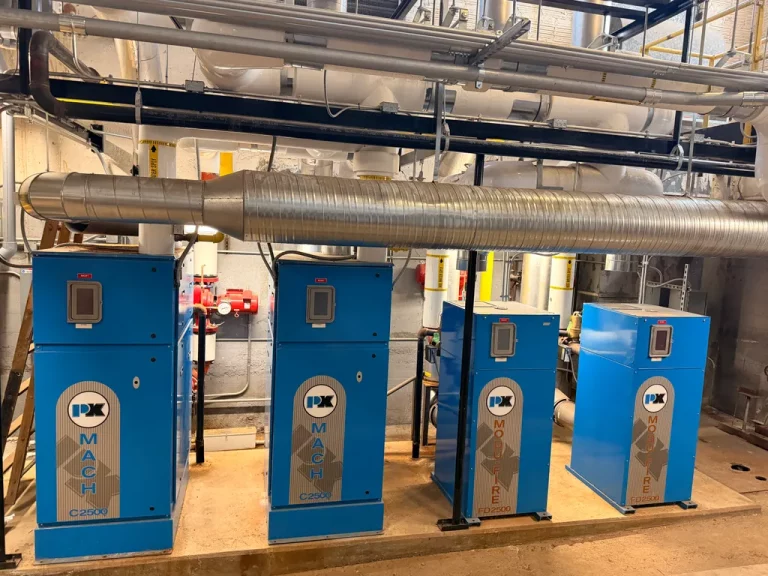
Hybrid Mach C2500 and ModuFire boiler plant, part of a hybrid school boiler, improving part-load efficiency and seasonal control.
Introduction: Facility Profile and Project Stakes
School in Tully New York is a K–12 facility in Tully, New York, where dependable comfort heat supports safe occupancy, consistent scheduling, and uninterrupted winter operations. The heating plant uses a hybrid school boiler configuration with Mach C2500 and ModuFire boilers to match capacity to changing loads across the school day. Adirondack Combustion Technologies (ACT) was engaged to support stable operation, safe combustion performance, and an operator-friendly system approach that helps the facility team maintain comfort through cold-weather peaks and shoulder-season variability.
Project Overview: Existing System Constraints and Risks
K–12 buildings see rapid heating load changes driven by morning warm-up, occupancy swings, and weather shifts. When the plant cannot stage cleanly, facilities often experience temperature drift, short cycling, and increased maintenance burden. In addition, boiler rooms in active schools require predictable operation and clear service access to reduce disruption.
Key constraints and risks included:
- Limited tolerance for downtime in an occupied school.
- Higher nuisance-alarm and service exposure when boilers cycle excessively at part load.
- Operational risk during cold snaps when peak capacity and control stability are both required.
Solution: Selected Equipment and System Design Rationale
ACT supported a hybrid boiler plant configuration built around Patterson-Kelley equipment to improve how the system responds across the full operating range. The combination of a high-capacity unit and modular boilers allows the plant to stage efficiently during part-load operation while still meeting peak heating demand.
Design rationale focused on:
- Smooth staging and stable supply temperature control under variable school loads.
- Combustion management and safety verification aligned with institutional requirements.
- A plant layout that supports serviceability, clear operating baselines, and repeatable seasonal adjustment.
Consultative Execution: Engineering Approach and Coordination
ACT’s work emphasized coordination and verification so the hybrid system operated as intended, not just as a collection of installed components.
Primary support included:
- Reviewing load patterns and staging behavior to align the hybrid strategy with real operating conditions.
- Coordinating with engineers, contractors, and facility staff on commissioning priorities and acceptance checks.
- Supporting system turnover and operator understanding around staging, setpoints, and routine maintenance checkpoints.
The objective was to reduce day-to-day operational guesswork by making system behavior predictable and by ensuring the facility team had a clear reference point for normal operation.
Results & Operational Impact: Post‑Installation Performance
This project prioritized operational stability and maintainable performance rather than aggressive efficiency claims. With a hybrid boiler approach matched to school load variability, the facility improved its ability to maintain consistent comfort heat while reducing part-load operating issues.
Notable operational impacts included:
- More stable heating delivery during morning warm-up and mid-day transitions.
- Improved part-load behavior through cleaner staging and reduced cycling tendencies.
- Clearer operator control through predictable setpoints and a serviceable boiler-room configuration.
Why This Matters for Similar Facilities and Applications
Across New York, K–12 schools, municipal buildings, and campus facilities often operate at part load for much of the year, yet still need strong peak capacity during cold snaps. Hybrid plant strategies can help facilities maintain stable temperatures, reduce cycling-related wear, and improve day-to-day manageability when the system is selected and commissioned with load behavior in mind.
Adirondack Combustion Technologies supports similar facilities by applying an engineering-informed approach to boiler selection, staging strategy, and commissioning support. ACT can apply the same framework to other institutional buildings where comfort heat reliability and part-load control are critical.
Request a Free Specification Quote
Request a free specification quote for an engineered, no-obligation review for commercial, industrial, or institutional facilities in New York. ACT can review loads, code considerations, venting constraints, and mechanical room space to define a boiler solution that fits your operating requirements.